What is your quick service restaurant doing to prepare for the upcoming trends in 2012?
Tag Archives: restaurant consulting
Free server sales training video
Here’s a free server sales training video from US Foods. It’s pretty good, and under 10 minutes, which I think is important. Word of warning though, it does contain a pitch for their HotOperator menu design service. The video does talk about great menu design tactics though which we also incorporate into the designs we do for restaurants.
Choice beef prices may rise next year | Nation’s Restaurant News
Restaurant Communication – How to use a Manager’s Log to get everyone on the same page
You hear it in every business, “We need to communicate better!” What does that mean though? I think we all understand that sharing information is a key function to operating a successful business. Whether its letting someone know a key piece of equipment is broken, or making a history of sales numbers or staffing levels, there are many pieces of information in a restaurant or food service that, when properly shared with your management staff and employees, can greatly increase your efficiency and profitability.
The big question is, “How do I share that information?” What are YOU going to do to communicate better with your staff? In today’s information age, there are a lot of ways to communicate including email, calendars, blogs, websites, hand-written notes, meetings and line ups just to name a few. In my opinion, the best forms of communication are those that also create a history of the information you are communicating. This history is a great tool of accountability when things go wrong, and a great planning tool to keep things from going wrong in the first place. In addition to email, the best all around tool for communicating are Manager’s Logs. They give you a place for all your management staff to record key pieces of information to give you a history of what happened on a shift, and a list of things to do to plan better for subsequent shifts. More importantly, they remind your staff to save information that they might not otherwise think to share with you, like how much sales you did in each shift; whether you were over staffed or under staffed; whether you ran out of any products that need to be reordered; who showed up to work on time and who was late.
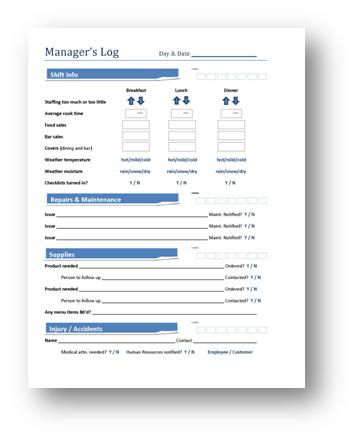 Here are some key components that a good Manager’s Log should include:
- A record of whether you were staffed correctly
- Average ticket times from the kitchen
- Food sales recorded by the meal period
- Alcohol sales recorded by the meal period
- Covers
- Weather information
- Accountability for your duty checklists
- Repairs and maintenance needed
- Menu items that were 86’d
- Supplies that need ordered
- Employee and customer injuries and accidents
- Customer lost and found
- Employee performance and attendance issues
- Information covered in line ups
- Customer feedback
All of this information is important to communicate to every member of your leadership. While a breakfast manager might not necessarily need to know how many people ate for dinner the night before, having that information may help them better understand why the previous shift didn’t stock silverware, or why you are depleted of key inventory items. Proper communication helps foster a proactive management environment that gets all your leadership on the same page, lessens finger pointing and rivalry, and gives you vital information to plan better for following shifts.
One other major advantage to using a Manager’s Log is having information gathered into one easily accessible location for you use for your other reports. From the information gathered in the Manager’s Log, you can create a history of food or alcohol sales per shift, track your customer counts for each meal period into a spreadsheet, or update employee personnel files.
To make it easier to gather and save this information, several companies sell pre-printed Manager’s Logs. Two of the most known are CommLog and the Manager’s Red Book. While I do think the products from both these companies are great, you can end up paying a lot for what is essentially paper printed with spaces for you to fill in. Their pre-printed books range from $180 – $275 per year, every year. Completely worth the cost if you know what the benefit is, but if you read any of my articles, you know I like to build and offer my own comprehensive tools. Starting today, we are offering our Microsoft Word document versions of our Manager’s Log for a one-time cost of $25. With our ready to use Manager’s Log, you have the digital copy yourself to edit if you like, and print off month after month after month, without ever having to buy it again. The only stipulation is that you agree not to give away our copyrighted downloads to other restaurants, but please feel free to send them to our download store to purchase their own. You find our download store on the main O’Dell Restaurant Consulting website. Our Manager’s Log is simple to use and can help you get even the most novice of managers or supervisors actively involved in improving your restaurant or food service.
For questions regarding your restaurant or food service and ideas on how we can help you pull more profit from your business, please contact Brandon O’Dell from O’Dell Restaurant Consulting.
Brandon O’Dell
Brandon@bodellconsulting.com
(888) 571-9068
How to roll out a new restaurant menu
One of the scariest things to do for a restaurant owner is to change their menu. There is nearly always a fear that taking one wrong item off the menu will result in all a restaurant’s business slowly dwindling away. There’s a fear that raising prices will chase off all the customers, that EVERYONE will see all the changes and rebel!
In years of working with restaurant owners, private clubs, colleges and concessions with menu changes, I have yet to see any of these fears materialize. In reality, the fear itself ends up causing more problems than the changes do. After a menu change, owners are relieved they took the leap and thankful for the extra revenue. While most changes go unnoticed, the longer a restaurant waits to change their menu and raise prices, the higher the price increases have to be and the more likely they will be noticed. Price increases are much less likely to be noticed when they are done more often in smaller increments.
Instead of waiting a year and raising a price $1, you should raise it $.25 every three months. These smaller, more frequent changes also result in higher cash flow during the year. Here’s an example of how much this method can increase your cash flow. I suggest changing your menu at least every 3 months. This allows an opportunity both to keep the menu new and exciting, and to make the more frequent and smaller price increases I mentioned.
Realizing that it is better to change your menu and increase prices more frequently is one thing, but doing it could be quite another issue altogether. Without the right process, changing your menu can be a big project. With a good process however, it doesn’t have to be.
To help you through the process of changing your menu, we’ve created this list to help walk you through each step. Here it is.
Steps to rolling out a new restaurant menu
Set parameters to make your menu “manageable”
– Before you just start writing down all your favorite items to cooks, you need to set some rules for your menu. Chances are, you have a lot more great recipes than should really be on one menu. It’s okay not to squeeze everything on one menu. Save some of those great recipes for your next menu change or for chef features.
As a “rule of thumb”, I suggest to restaurant owners and chefs to keep their menus small. In most cases, 10 starters (appetizers, soups, salads), 10 main dishes (entrees and sandwiches), and 5 desserts are plenty. This provides your guests with plenty to choose from while leaving you with room on the menu to write great descriptions that sell the food. This small menu also allows you the time to create great nightly or weekly chef features. By not making your menu overly large, you can focus on making items from scratch and having fast production speeds.
Another “rule” I have is to require that every single ingredient in your menu items be used on at least two dishes. This helps increase inventory turnover and reduce the chance of product going bad before it is used up.
You should also have a plan, and even menu items, for making use of product that you have to over produce. For example, if you have a roasted chicken dish on your menu that has to be prepared before service but cannot be reused the next service, you need to have another dish to use the leftover chicken for, such as a chicken salad sandwich or wrap. Having a plan for extra prepared food will do a lot to reduce your food costs. If you utilize nightly or weekly features, these can also be an outlet for this food.
Perform a menu engineering analysis
– There are many tools for doing this, but you don’t really have to have the same type tool we use to perform a menu analysis. You simply need to determine which menu items are making you money and which ones aren’t. There are four classifications for menu items; dogs, workhorses, stars and challenges.
- Dogs are menu items that have a low profit contribution margin and low popularity.
- Workhorses are menu items that have a low profit contribution margin and high popularity.
- Stars are menu items that have a high profit contribution margin and high popularity.
- Challenges are menu items that have a high profit contribution margin and low popularity.
It’s usually a good idea to remove the “Dogs” from your menu, keep the “Stars” and “Workhorses”, and change the “Challenges” to try and turn them into “Stars” or “Workhorses”. You may also wish to remove the “Challenges” in favor of new menu ideas you have.
Choose menu items
– Once you have your menu items categorized based on their profit contribution margin and popularity, you have to decide which items should stay on the menu, which should come off and which ones need tweaked. If you are a new restaurant, your biggest challenge will be resisting the urge to put everything you want, or everything you have the ability or product to make, on the menu.
Smaller menus are more efficient and more profitable. They usually result in shorter ticket times, lowered labor hours and increased sales and profitability. Not to mention, it’s a lot easier to change and roll out a small menu than a large one. For existing restaurants, the hard part is following through with removing slower moving menu items instead of just adding new ones to the list. If you run features, you have a great tool to identify menu items that could be popular on your new regular menu.
Write recipes and descriptions
– Using recipes keeps your cooks consistent. You need your customers to receive their favorite dishes tasting exactly the same no matter who cooks them if you want to keep them coming back. Recipes also help you price out your menu so you know what everything costs. Without knowing the cost of a menu item, you can’t know what you must price it to make a profit.
Descriptions serve a dual purpose. They both describe the dish on the recipe sheet to the cook, and they describe the dish to the servers. Restaurants often make the mistake of not sharing a detailed enough description with the servers for training purposes. They should be able to visualize the dish being made from your description.
Perform a menu matrix analysis
– A menu matrix analysis is done to make sure the production of your new menu is balanced out across your restaurant equipment so no one piece of equipment or station is overloaded. To perform this analysis, simply create empty boxes on a sheet of paper that represent each piece of restaurant equipment in your kitchen, including steam wells and make stations. If you have multiple fryers or other pieces of equipment, create multiple boxes for each piece. Go through your menu item by item and list every component from every menu item inside the box representing the piece of equipment it is prepared on or served from during production. You do not need to list items that were already listed for another piece of equipment. When all components are listed, your equipment should have an “equal” (or close to it) number of items under each piece. This helps spread the menu workload across the whole kitchen line.
Create a menu training packet
– This is simply a list of all your menu items in the order they appear on the menu, complete with the detailed descriptions from the recipe worksheets.
All menu items are included on the list whether they are new or not. The training packet should contain a glossary at the end with definitions of any culinary terms used in the descriptions. Remember, servers don’t often go to culinary school. They need taught what these terms mean. At the end of the training packet should be a list of the items that have been removed from the menu. If they are to go into rotation as Features, that should also be shared so servers can alert any customers who may have had those items as a favorite.
Create a menu training test
– This does not have to be a daunting task. It can be as simple as taking your training packet and removing words from descriptions and replacing them with “___________” spaces for servers and cooks to fill the spaces in with the missing term or ingredient. An alternative would be to create 2 to 3 questions about the preparation of every menu item for the servers and cooks to answer without the benefit of having the description in front of them. The point isn’t to make the test really hard, but to force servers and cooks to study the new menu. Servers should not be allowed to work with the new menu in place until they achieve a 95% or better score on your menu test. Cooks should have the advantage of having a recipe manual on the line to reference as needed. There should still be great encouragement to learn the new menu though.
Create a recipe manual
– Every menu should have a recipe book that serves both as a reference when starting a new menu and a training guide for new cooks. A recipe book is simply organized for quick reference. There should be tabs for each section of the menu, and the recipes in that section of the menu should be put into the recipe book in the same order they appear on the menu. Each recipe should also have a printed picture of how the plate should look when properly made placed directly after it in the book. The pages will appear as “recipe”, “picture”, “recipe”, “picture”, etc. Some other things you may want to add to the back of your recipe manual as a training tool would be pictures of properly prepped menu ingredients.
Create a prep list
– A prep list is a standardized tool that allows a chef, sous chef or line supervisor to plan the prep for the day. There should be a separate list for every station unless your prep is small enough to fit all on one page. If it is small enough, items should still be separated by station. This list should have a line for every item to be prepped in each station and columns where you can put how much is to be prepped for a regular shift, how much should be added or taken away from that amount for the current shift, how the item should be cut, cooked or otherwise, what size of container each item should be put in, what type of portioning utensil should be used for each item, and lastly, a column to record how much of the prepped item is left from the shift. This will help the supervisor adjust prep levels and control waste.
Create a line setup diagram
– A line setup diagram is a basic layout of how prepped items are placed into cold stations, steam wells, bain marie’s, etc, and where extra prepped items should be stored inside of refrigerated units. The chef or sous chef will know better where to place prepped items to maximize production speed. It is important they are telling the cooks where to place these items and not the other way around. Don’t ignore a cook’s input if they have a suggestion though.
Design the menu
– Designing a menu isn’t as simple as making a list of everything you want to sell and adding a price. There are certain things that make a menu more effective and increase your sales. Not all parts of the menu real estate are equal. Typically, people remember the first and last things that they read whether its a menu, an article or a book. The details in the middle fade the fastest. This means the most valuable menu real estate are the first and the last places on the menu the customer looks. Items with the highest dollar markup should be placed in these ares of the menu to increase their opportunity to be seen. Ideally, your highest profit menu item goes right in the center of the menu. That is the first and last place a customer sees on your menu. Other psychological selling tactics used in menu design include: never putting prices in a straight column so as to allow customers to shop for the cheapest items easily; not using “$” signs or “………….” to lead customers to the prices; never putting the price in a larger or bold font to make it stick out; using highlighting, boxing, icons, color and pictures to lead people to high profit items; and rounding items to an even number or to the closest “.09” instead of “.o5”, effectively gaining $.04 on every sale. The front of the menu should include all contact information and a description, landmark or map of how to find the restaurant if it is difficult to find, in addition to the name, logo, website, Facebook and Twitter info. The back can be used for desserts, beverages or to market special events. Daily Features should appear on an insert placed in the menu and/or be described to every table by the server directly.
Practice the new items
– For weeks prior to rolling out a new menu, new items should be run as specials to get both the kitchen and the service staff familiar with those items. Both cooks and servers should be allowed to taste the new items. Practicing serves both as a good training exercise and as an opportunity to get feedback on new menu items and tweak them before you roll them out.
Promote the new menu
– Promotions to hype a new menu should start at least one month before rolling out the new menu. It’s hard to build hype for anything in less than a month. If you know some of the new menu items you have planned, share them with the service staff so they can talk them up to customers who are curious. If you have an email list, hype the new items via email. Talk about them on Twitter and Facebook. Mention them on your website. Create a poster for your entryway. Put an insert in your existing menu. Put table tents up to promote them.
Don’t forget the desserts
– It’s just as important to change your dessert menu as your regular menu. Dessert menus are usually smaller and require more frequent changing to keep them fresh and interesting. If you want to keep your dessert sales up, keep things exciting on your dessert menu without making a huge, burdensome dessert menu that slows down production.
Roll it out
– Make sure to meet your own time goals for rolling out the new menu. There is very little more annoying to a customer than to have something hyped to them for a solid month, then not delivered on the day you promised. If you are following all my steps, the real work is going to be done long before the roll out date and you shouldn’t have any problem meeting your deadline.
Don’t be intimidated by all the steps and details of rolling out a new menu properly. Sure, it’s a big project the first time, but the second time you roll out a new menu, most the work will already be done for you. It gets easier every time. Within a year, you’ll be a pro. Your staff will be more knowledgeable, your production line will be faster, your food will be more consistent and your customers will be happier. All that works to earn you more profit for your restaurant, and isn’t that what owning a business is all about?
Brandon O’Dell
O’Dell Restaurant Consulting
www.bodellconsulting.com
blog.bodellconsulting.com
(888) 571-9068
Brandon O’Dell is an independent restaurant consultant that offers operating, marketing and strategic planning advice for restaurants and other food services. O’Dell Restaurant Consulting is based out of Kansas City, KS and offers assistance anywhere in the U.S.
Leading Fast Casual Restaurant Chains Not Only Weathered the Economic Storm, They Prospered, Reports NPD
Keeping it simple: How to create a restaurant concept that can succeed
High failure rates for restaurants. Yes they’re exagerated, but they’re still high. According to recent studies from Cornell and Ohio State universities, 59-60% of restaurants fail within the first three years. As many as 75% may fail within the first five. Why are they so high? For a list of the six biggest reasons, see The biggest mistakes restaurants make, and why they have a high failure rate.
For the purpose of this article, I’m going to talk about a key fundamental in restaurant concept design, keeping it simple.
Big menus with too many items, oversized dining rooms, multi-ingredient dishes, huge liquor selections and wine lists and over decorating. They’re all symptoms of the same problem, overcomplicating your concept.
As a restaurateur, you may find yourself getting bored with traditional menu items. For you, eating in a restaurant might need to be an adventure. You may have to see or try something you’ve never seen before to be impressed. Very well. I’m the same way.
This may be the underlying factor in why restaurant owners routinely go overboard when designing their concepts. They push their own sensibilities on the general public, not realizing that their tastes are the exception to the rule, and not indicative of the tastes of the public at large. Restaurateurs think they need to present every dish possible to make out of the ingredients they already carry. They think carrying 15 scotches instead of 5 will earn them more customers. If you have a larger selection, you’ll appeal to more people, right? Wrong.
Trying to please everyone leaves you unable to be defined. When you have too many colors in your decor, too many styles of fixtures and furniture, and menu items that represent too many styles of cuisine, your customers find it harder to describe you and recommend you. You find it harder to manage your business effectively and market your brand. You’re trying to stand for too many things at once. Cut out all the extras and keep it simple.
Here’s a short list of things you can do to keep your concept simple.
Choose two contrasting but complementary colors to design your concept around. You may use a third neutral color for accenting, but stay away from unneeded detail and too many extra colors in your scheme. To create a solid brand, you need to be more than attractive, you need to be memorable, and that means keeping your color scheme simple. Use these colors to design your logo, signage, marketing, and to decorate the inside and outside of your restaurant.
Keep your menu small. This serves many purposes, some of which are outlined in my article, Creating a manageable menu. A small menu is easier to control costs on, easier to prepare and order for, and easier to provide consistency with. By having a small menu, your service will be faster, your food quality will be better, and you’ll make more money. Keep your menu simple.
Keep your dining room simple. Smaller dining rooms are easier to manage. If you’re thinking of opening your first restaurant, don’t build a huge dining room with 200 seats. A large dining room takes a large management staff and lots of employees to run. If you find that your 80 seat restaurant gets full every night, then build another one. Don’t worry that you’re not building it big enough.
Keep your market simple. Don’t convince yourself that you want all people of all demographics to like your business. It’s not going to happen. By going after “everyone”, you’ll end up with no one. Even if your style of cooking has mass appeal, your location will determine who is most likely to come into your restaurant. Identify those person’s age, income level, sex, marital status and religion. They are your target market whether you like it or not. If your concept doesn’t appeal to the people in your area, then you don’t have a feasible concept and you aren’t likely to succeed. Keep your demographic simple and focused. For more on identifying your target market, read this article.
Keep your menu dishes simple. When you have too many ingredients, and/or too many touches that need to be made to the dish after it’s ordered, before it goes out, you slow down the production of your food. A ticket will only go out as fast as it’s slowest dish. Keep your food simple and easy to produce. Let the ingredients be the stars and don’t lose them in a mish mash of flavors.
Don’t try to carry every liquor any possible customer could want. If you don’t have Glen Fiddich, but you do have five other single malt scotches, any reasonable customer is not going to overlook your restaurant next time because you don’t carry their particular brand, and for the one in 1000 customers who will, so what. It is more important for you to have a manageable inventory and a selection small enough for your staff to become knowledgable on than it is to try and please every customer’s sense of taste. I’ve got a secret for you. Even if you carry 30 different vodkas, you’ll still end up with someone requesting one you don’t have. Keep your liquor and wine selection simple.
While this is the end of this short list, it’s not the end of the application of this fundamental philosophy of restaurant concept design. Any time you have the opportunity to simplify your concept, take it. You’ll end up with something that is simpler to manage, simpler to market, and simpler to turn a profit with.
Brandon O’Dell
O’Dell Restaurant Consulting
(888) 571-9068
brandon@bodellconsulting.com
www.bodellconsulting.com
Chef Employment Contract now available for download!
We’ve just added an employment contract for chefs and cooks to our web store at www.bodellconsulting.com/webstore.html.
This contract template will help you avoid potential problems if you happen to lose your chef like:
- Not having ownership of the recipes for your menu
- Your chef going to work for your competitor
- Important documents and management tools being taken for use
- Proprietary secrets being divulged
A good working relationship requires mutual benefit and trust. Create an atmosphere of trust by spelling out your employee/employer relationship in an employment contract that defines all the terms of employment and protects both you and your chef.
This contract template is a Microsoft Word document and can be edited for use with other management, employees or sales staff.
Disclaimer: O’Dell Restaurant Consulting is not a legal advisor and this contract and all included should not be considered legal advice given to anyone using it. Check with your attorney on enforceability of all areas of this contract and use a qualified legal professional to assist you in making sure all employee agreements are legal and enforceable.
Click the “Buy Now” button to purchase our contract directly for $25:


Who owns your kitchen’s recipes? Has your chef signed an employment contract?
A popular topic lately in a couple different restaurant discussion forums I participate in is the question of who owns the recipes your restaurant uses?
Let’s look at a couple possible scenarios that could affect your restaurant.
- Your executive chef or kitchen manager quits. Maybe one or two members of the kitchen staff leave with her/him. Your chef keeps extensive recipes written down in a book they’ve had since long before they worked for you.
- You fired your executive chef and there are no written recipes. Everything comes from the head of the executive chef or the cooks he/she trains.
- Your chef leaves your restaurant for a bigger, better opportunity. It’s a benevolent departure. No animosity.
What happens next in any of these scenarios? Do the recipes the chef has written down belong to the restaurant? Does the restaurant get them when the chef leaves? If there are no recipes, can the restaurant make the chef create them before the chef leaves so the restaurant can continue to produce the same food? Are any of the cooks trained enough to recreate the recipes the chef used to make? Is this cook even going to stay when the chef is gone?
No matter the answers to any of these questions, it is very important for the continued success of your restaurant that you are able to consistently produce the same quality of product, tasting the same as before, if you want to keep the loyal customers you have. If the food was horrible, maybe you want to change all the recipes, but you’ll still want to pay attention to the rest of this article to avoid potential pitfalls with the next chef.
All this begs the question, “Can your restaurant survive the departure of your head chef or kitchen manager?”
In addition to helping you evaluate your current situation and the risk you already have if your head chef leaves, I’m also going to help you take the steps to lower your risk and remove the impending doom of losing your top chef.
What are the risks if my chef leaves?
If you are unfortunate enough to lose your executive chef, whether it be a termination, the chef quitting, or the chef moving on to a better opportunity, there are several potential problems they could leave you with and several considerations you may have never made.
- Recipes can be copyrighted, but copyrighting doesn’t keep someone else from using the same formula or recreating the same food. It may only protect any unique methods or systems of creating the food. In effect, you may not be able to keep a chef from reusing the recipes you use at a restaurant down the street just by copyrighting the recipes.
- The chef may consider the recipes they create as their own intellectual property. If they were created while working for you, doesn’t that make them your property? Does a researcher for Pfizer get to keep the cure for cancer if they create it while working for Pfizer? “Who owns my recipes?”
- A chef you have fired or who quits, even one who leaves under good terms, may not feel compelled to leave you with the recipes created while they were working for you.
- A chef you have fired or who quits may think it’s a good idea to go to work for one of your competitors and make the same food you serve to hurt your business.
- A chef or cook who leaves your restaurant may think it’s a good idea to start their own restaurant using the recipes they learned at your restaurant.
- The chef takes half your kitchen staff with her/him, including everyone who knows how to make your recipes.
- The chef takes their recipe book with them which are the only written copies of the recipes to your food.
- You’re left without a chef and without recipes. You are in a state of desperation while having to negotiate employment with the next chef you hire.
Any one of these problems could do some serious damage to your restaurant. It’s best to consider these issues before hiring your chef and create an employment contract that protects the quality and consistency of the food you serve. Without that quality and consistency, your restaurant is at great risk to fail.
Now that you know it’s very important to protect yourself from these potential problems, and I’ve told you that an employment contract can help, you’re lead to your next question, “What should be included in a good chef employment contract?”
Here are what I consider to be “must haves” in any chef employment contract. Many of these you will want to include in an employment contract for all your cooks, your General Manager and any other key management staff that have access to your proprietary secrets.
- A statement of duties, as in a job description. Usually an addendum to an employment contract, a job description helps you define in writing what is expected of the chef or other employee. The job description should be acknowledged and signed by the employee so you have proof the employee was aware of their duties.
- The job description MUST include “creating and recording recipes in a recipe book owned exclusively by the restaurant” as one of the duties.
- Intellectual property. This statement declares that any work done by the chef or other employee, recipes or operational tools created, procedures, etc. are the property of the restaurant and remain the property of the restaurant upon termination of employment. The employee is being paid by you to create for you. The creation remains your property just as it would if you commissioned a piece of art or hired a researcher to find a cure for cancer.
- Conflict of interest statement. For full time, key employees, you will want a statement in their contract saying that while under your employment, they cannot hold another job or engage in any business or activity that conflicts with the interests of your restaurant. This is not a reasonable expectation for part time employees in my opinion though. If you are not providing enough hours so that the employee does not need another job, you should not try to prevent them from having one. Your employees have to eat too.
- Confidentiality agreement. This statement in your employment contract forbids the employee from divulging any of your proprietary secrets to anyone else. These secrets include recipes, financial information, operations tools and manuals, policies, vendor agreements, training practices, technology, food and service methods, techniques, processes, studies and any and all records kept by the restaurant or any of it’s employees. This statement specifically helps you prevent your chef or cooks from taking your recipes or procedures down the street to your competitor.
- Surrender of company documents. Upong separation of employment, this statement requires that the employee surrender any and all documents and property belonging to the restaurant, including recipes, checklists, operating tools, manuals, agreements, and any document whether printed or digital that was created on the clock while working for the company or was provided by the company to the employee.
- New employer notification. This states that you reserve the right to contact the employee’s new employer to divulge to them the terms of the employee’s employment contract with you. This is meant to help you let the new employer know that their new hire is under contract not to divulge your proprietary secrets, procedures and recipes.
- Non-compete agreement. The greatest risk of a good employee leaving is that they will go to a direct competitor and try to compete with you. A non-compete agreement helps you prevent them from doing just that. A non-compete should state that an employee can not work for, consult with or own interest in a similar business in your market. Basically that they can’t compete with you. A non-compete cannot keep an employee from making a living however. If you create a non-compete that tries to prevent an employee from performing any job even remotely similar to the one they held with you, you may have trouble enforcing it. Laws regarding non-competes vary from state to state and your ability to enforce yours may vary greatly from a restaurant in another state. In reality though, you are not trying to prevent your chef from finding a job somewhere else. You are trying to prevent them from taking your trade secrets and competing against you with them. A non-compete normally contains a time limit. 24 months is customary for most non-competes.
- Employee solicitation statement. This statement forbids an existing employee from soliciting your other employees to work for them. This includes not only a direct job offer, but any sort of enticement, encouragement or pressure of any sort.
There are several other statements you should include to create a good contract. Make sure to use a qualified lawyer experienced with labor law and restaurants when creating any contract of any sort. I am not a lawyer and you shouldn’t consider this article legal advice. What this is however, is a good place to start when trying to protect proprietary information like recipes.
Until you have an employment contract in place, and a job description letting a chef know they are creating recipes for you that you will own, you are at the mercy of their ethics. A great chef knows that they are only as good as they left their last kitchen. They should have the moral drive to set any kitchen they run up for success long after they are gone. They shouldn’t try to steal employees or hide recipes. After all, a great chef can recreate a recipe anytime they wish, and there’s a never ending supply of recipes inside a great chef’s brain. You can’t depend on every chef you hire being a great chef however. You need to protect yourself and create an atmosphere that benefits not only your chef, but every employee in the kitchen.
Use employment contracts. Use job descriptions. Create and maintain up-to-date recipes on all your menu items, including the specials. Make sure you have copies too. Don’t be held hostage by any one employee. Create an atmosphere where chefs will be beating down your door to work in your organized, well run operation, just for the opportunity to express their own creativity. For the opportunity to work for a successful brand, and to have the freedom of creating to their hearts content because you’re not holding them back from insecurity that they may some day move on to bigger and better things. After all, if you hired a great chef, they will eventually move on to bigger and better things.
For help writing an employment contract for your chef or cooks, visit our webstore and look for our Employment Contract for Chefs and Cooks. This same contract can be amended to use for any employee.
Brandon O’Dell is an independent restaurant consultant who assists small to medium sized independent restaurants and small chains create the operational systems their chain competitors use everyday. Visit www.bodellconsulting.com for more information, or visit their blog at blog.bodellconsulting.com.
Restaurant Review – Waxy O’Sheas in Shawnee, KS
I’ve decided to start a new category of posts for the O’Dell Restaurant Consulting blog that I think will be very beneficial to restaurant owners everywhere. I am going to review restaurants that I have been to. These are not reviews from strictly a patron’s standpoint, but from the standpoint of an experienced food service professional and consultant. I will attempt to identify strengths and weaknesses in the operations of a restaurant and make suggestions on how the particular restaurant could maximize these strengths or overcome the weaknesses. Please read the following disclaimer:
Disclaimer: This review should not be read as an endorsement or warning for or against patronizing the described restaurant. It is intended strictly as a study of the restaurant’s operation, perceived weaknesses and strengths, and suggestions on how to improve the operation. As this review is not sanctioned or paid for by the owner, it is not meant to be a comprehensive review such as one O’Dell Restaurant Consulting provides to it’s clients. It is strictly superficial. There has been no discussion with the restaurant owner about these observations and no back of house or office visit has taken place to gain perspective as to the cause of the problems. My assumptions are based on my experience and may not necessarily reflect the actual cause or source of an issue.
Now that the disclaimer is out of the way, let’s get to my review. I will break this review down into three sections that describe different key parts of the operation; reception, service and food. Future reviews may contain other parts of the operation I have also been exposed to, such as marketing.
Waxy O’Shea’s Irish Pub – Mother’s Day 2010
Reception
Mother’s Day or Easter are traditionally the busiest days of the year in a restaurant. Many restaurant, like Waxy O’Shea’s, offer a brunch buffet. The intent of offering a buffet is to serve as many patrons as possible in as short a time as possible. On a day like Mother’s Day, it is especially important for a restaurant to process customers quickly. There are many customers to be served and the more customers served, the more sales dollars to be made.
Quick service for a buffet starts with the reservation (or no reservation) of tables and seating of customers. In order to process the most customers possible, a restaurant must have a good system in place to get customers from the door to the floor. Our first observation about Waxy O’Shea’s came when calling to make a reservation. Waxy O’Shea’s does not take reservations on regular business days and did not take them for Mother’s Day. Not taking reservations normally serves two purposes for a restaurant:
- No reservations means no empty tables being held open while the restaurant is waiting on the reservation to arrive. When there is a steady stream of customers, not having tables sitting empty for reservations means the restaurant can serve the maximum amount of customers their staff can handle during their rush. This normally means maximized sales.
- No reservations also eliminates the work of processing phone calls, tracking reservations and setting up a dining room to accommodate those reservations.
Not taking reservations sounds like a good idea, doesn’t it? In theory, it is, and it works for many operations. However, on the busiest days of the year, not taking reservations eliminates some advantages that can be gained through better planning.
- Taking reservations means being able to adjust hostess, bar and service staff to make sure your customers are best served.
- Taking reservations means being able to adjust food production to reduce waste, or more importantly, to make sure there is enough food to serve everyone.
- Taking reservations allows you to plan ahead for large tables and reservations that require you to separate or put together tables in your dining room.
- Taking reservations means having some control over the flow of customers in and out of your restaurant, allowing you more direct effect on their dining experience.
Whether or not taking reservations is a good idea for your restaurant depends on your ability to handle lines of people, clean and reset tables and give proper service.
Here is my observation on how Waxy O’Shea’s did in receiving and seating their customers.
First, I believe Waxy O’Shea’s would have benefited greatly by having a reception area for customers. The restaurant has a small wind break foyer, then a small receiving area inside the front door. The left side of the restaurant is the bar and the right side is restaurant seating. The small receiving area inside from the foyer has a floor standing specials board with a couple plants behind it. There is also a floor standing specials board in the foyer. In my opinion, the second one inside the door is redundant and the space would be much better used as a reception with benches for patrons who are waiting. Instead of a hostess stand, there is a shelf in the hall to the dining room where the menus are set, with a stool beside it where the floor plan with sections on it is kept. The look is very unprofessional and I believe this area would be best utilized for additional seating for reception. In all, I believe there is room to create seating for 12 or more patrons at the front of the restaurant. I’m sure the owners of the restaurant would question where to set up the menus and floor plan. I believe there is also plenty of room for a free standing podium with shelves inside, though I would rather see a built in hostess stand with a telephone line ran directly to it.
Another observation about the seating process of Waxy O’Shea’s was their lack of hostess staff. One person, who may have been an owner, had a note pad to take names for a seating list. While she did a good job with keeping everyone straight who was waiting for her to add them to the list, she was also trying to help clear and set tables for seating which took her from the front. While we were already on the list and waiting for a table, four groups of customers came in and waited to be put on the list. They were all added to the list in the right order of their arrival, but what the hostess/owner did not see was the 3 groups that came in the door, were not greeted and left to go eat somewhere else. The lack of a good setup and system cost the restaurant at least $200 in sales just in the 20 minutes I was waiting for a table.
On the positive side, we were able to come in the front door of the restaurant, put our name on a list, and get seated in 20-25 minutes. That was pretty good for Mother’s Day. However, I was very disappointed to see that after waiting for 20 minutes, and counting around 20 people waiting behind us, there were 13 tables in the dining room that were no longer full. Lack of a good system and slow processing caused all those people to wait while the restaurant could have been serving them and earning dollars, in addition to serving the others that decided not to wait. To someone walking in the door, the restaurant was full and the wait looked to be an hour. In reality, half the tables in the dining room were empty and the hostess was on the floor instead of greeting them and explaining the situation.
In addition to changing the reception setup, I believe Waxy O’Shea’s would have greatly benefitted from being adequately staffed for reception. In a restaurant that seats likely 200 people, a day like Mother’s Day where the tables could have been turned 4 or more times would require at least 3 hostesses. There could have been a constant flow of patrons being lead to tables while another hostess helps put together or separate tables to set them to the right size, while the hostess/owner/manager was supervising the process and managing the waiting list.
Service
Upon being seated, our table was greeted by one of the waitstaff very quickly. I believe it is important that guests be at least greeted within the first 30 seconds of being seated. Mission accomplished. That server was taking care of another section, but the greeting acknowledged us and let us know someone would be with us shortly. Our server took 2 or 3 minutes to make it to our table, but on a very busy day that is acceptable, though not preferable. The server took our drink orders which included water and a couple bloody marys. She put our drink order into the POS to send to the bar, then went after the waters. The waters took longer than needed to get to the table, but not unacceptably long. However, the bloody marys didn’t come back on the first trip with the waters. It took more than 5 minutes to receive the bloody marys.
During the meal, the server returned to the table twice to clear plates and ask about needs and another time to refill beverages. A manager also cleared plates one time. This many trips to our table did provide the necessary visits to provide good service, however the server neglected to refill the coffee for one of the guests. Though this level of service wasn’t “bad”, it wasn’t impressive. My wife perceived this as the server not considering to refill her coffee. While the server did ask if we needed anything on a prior visit, a better trained server would ask specifically if the coffee needed refilled, or better yet would have just made rounds with a coffee pot and topped off every coffee cup in the section or even the whole dining room. EVEN better yet, the restaurant could have staffed bus persons to refill coffee, tea and water, in addition to clearing and resetting tables to allow for faster seating. There seemed to be enough servers staffed in the dining room, but no bus persons at all.
Here are some changes I would suggest to Waxy O’Shea’s to improve their service for future Mother’s Days and other busy days. I suggest having two bus persons in addition to the two additional hostesses. Between the bus staff clearing and resetting tables and the hostess staff seating customers quicker, Waxy O’Shea’s could have processed dozens more customers. Using bus staff to also refill teas, coffees and waters would not only increase the level of service and improve customer’s perceptions of service, but it would also allow servers more time to suggest, sell and replenish cocktails. Cocktail service could have been started at the reception area. If the bar is properly staffed and set up for speedy service, the cocktail sales on the day could have likely doubled. Another suggestion would be to set up smaller service stations through the dining room where water and tea pitchers could be kept for quick access. They could also keep a coffee burner on those stations for quick access to coffee. With just a tray jack, tray stand and a table cloth, you can create a very effective service station. One more step I would take would be to prefill glasses with water and ice and have them at the ready to set down as soon as the hostess knows how many patrons will be at a table. When the table is being cleared, a hostess can convey to the bus person that the table needs to be set up for “x” number of guests. When the guests arrive, their waters are waiting and the server can concentrate on selling them add-on beverages like tea, coffee and cocktails.
In all, I think the service at Waxy O’Shea’s was acceptable for a busy day, but “acceptable” should never be good enough. If you want to earn a great reputation, you need exceptional, not acceptable service.
Food
As far as quality goes, everyone at our table was pleased with the food offered at Waxy O’Shea’s Mother’s Day brunch buffet. Most their food, if not all, is made from scratch and well seasoned. The biscuits were light and fluffy and the prime rib was tender.
What I would have improved upon from a food perspective at Waxy O’Shea’s was the presentation of the buffet. The buffet was simply chafers lined up on a table. The salads were in several different types of bowls crammed together on a 4-top. The omelet station was an absolute mess by 11:00 am. I can only imagine what it looked like by the time brunch was over. The prime rib carving station was just as messy. The rib was being carved on a cutting board set inside a sheet pan, with tin foil covering the exposed rib to keep it from getting cold. Visually, the buffet was a disaster.
The first thing I would have done to improve the perception of the food would be to garnish the pans and bowls of food. Creative use of herbs, lettuces, colorful vegetables and fruits can do a lot to enhance the appearance of a pan of food with very little cost.
The next thing to do would be to have their carving and omelet stations moved to a different location. It’s hard to describe a restaurant layout on a blog, but the important thing to convey about the buffet layout is that the carving station and omelet stations were positioned beside the reception area on the opposite side of the area from the dining room. This drove much of the traffic to the stations through the guests waiting at the front of the restaurant. While I didn’t see any major occurrences from our table or while we were at the reception waiting for a table, there was a lot of cross traffic that could have resulted in a spilled and/or broken plate, stains on customers or even a slip and fall accident. Any of these things can pull needed staff and attention from the dining room and affect service and the customer’s experiences. The main part of the buffet was set along a wall inside the bar. A better place for the carving and omelet stations would have been anywhere inside the same room. Tables and seats could have been moved and recovered in the area where the stations were. The flow of the buffet would have been much improved and a lot of risk of potential accidents could have been avoided.
Along with moving the buffet, the overall aesthetic appearance of the buffet could have used a “woman’s touch”, or at least the touch of a create man. Chafers can be elevated slightly to give the appearance of levels. A nice centerpiece can be placed on the table with some flowers in in. Other decorations such as colored beads, fresh flowers, lemon leaf, leather leaf, ribbons or different colored linens can be used to fill space between chafers and liven up the appearance. The salad presentation could be spruced up with some attractive bowls and creative garnishing, different levels and the same decorations. I would also suggest to delegate the constant cleaning of the buffet to one kitchen staff member. This person should have a wet rag at all times to wipe off the excess food being spilled onto the table cloth. Messy spills can then be covered with clean napkins of the same color.
The appearance of a buffet can have a dramatic affect on the perception of the food by the customers. Great food on a nasty buffet suddenly becomes mediocre food. Mediocre food on a beautiful buffet becomes great food. Imagine what kind of impression great food on a beautiful buffet can make.
Summary
The lesson to be learned by this review is not to leave money on the table. With better staffing, a more guest friendly reception, quicker seating, faster bar service and wait staff more focused on selling “extras”, Waxy O’Shea’s could likely have increased their Mother’s Day sales by $2000.
If they take the extra step and improve the look of their buffet, they could move their price from the bargain $14.99 we were charged, up to $25 per person which is still less than other “nice” buffets they are competing against for customers. If they can pump through 400 customers on Mother’s Day with efficient systems, that extra $10 per customer could gross them an additional $4000 in revenue.
Done my way, their brunch could have easily yielded $6,000 more in sales while pleasing more people and earning more repeat business than how it was done. Take what I have observed at Waxy O’Shea’s and apply it to your big brunch days. Don’t forget that days of “guaranteed” traffic like Mother’s Day are a prime opportunity to build your customer database with names you could turn into regulars.
Brandon O’Dell
O’Dell Restaurant Consulting
www.bodellconsulting.com
blog.bodellconsulting.com
brandon@bodellconsulting.com
(888) 571-9068
 O'Dell Restaurant Consulting's Blog