
You do have a customer database, don’t you?

Communication. In one form or another, it may be the most important thing that happens within a restaurant. Just like your employees, your customers need to know what is going on in your business. How do you communicate with them?

If there is one thing I try to get across to every business owner, it’s that no matter how great your product is, if no one knows about it, it won’t sell. This fact makes marketing your most important job as a restaurant owner. You have an obligation to yourself to build relationships with your guests, and to let them know, with plenty of notice, every special thing that is going to happen in your business. The most effective way to do this is by collecting contact information from your customers and building a customer database.

A customer database is made up of key facts about every customer that comes into your restaurant. Your database should contain first and last names and addresses of your customers at a minimum. Email addresses, telephone numbers, birthdays, and anniversaries can help you make easier contact with customers and tailor special offers to them. You may also want to know favorite dishes, dislikes, and what day you collected the information.

The biggest benefit of a customer database is giving you the ability to spend your marketing dollars on those most likely to come into your restaurant… I’m talking about those who have already been there. To many owners, spending their marketing dollars on people who already know about their business seems like a waste of money, but the truth is that the greatest potential for increasing sales lies with those who already know where you are located, what you sell, and how great a value it is. These are the people who take the least convincing. You already have a relationship with these people.

Think about it, if you were giving away free booze to attract people to your house for a party, who are most likely to come, complete strangers or people who have been to your parties before? Your business is no different. Convincing people to come back more often than they had already planned is much easier that attracting new people, whether it’s a house party or a restaurant.

By collecting information from your customers, you give yourself the means to invite them back more frequently, to try and make them regular guests. You have the opportunity to get them to come back when YOU want them back, not just when the mood hits THEM.

There are several ways to collect customer information. You can simply ask for it, hand out comment cards with blanks to fill in with their information, offer a signup for a “VIP” club, or collect information for a prize giveaway. You may also want to think about contacting other merchants in your area to see if they have customer databases they may want to trade with you. Someone who visits another business close to you is also likely to give you a try since they make regular visits to the area.

Once you collect your customers’ information, you have many options on how to use it. With email addresses, you have an almost free way to communicate with your customers. Not all customers have email though, and some that do may not respond to email advertising. Direct mail newsletters are another option you have to contact customers. Newsletters can be used as more than advertising, you can offer stories about your restaurant, your employees, and your customers. You may even want to start a “Customer/Employee of the Month” contest and publish the winners in your newsletter. Another option is good ‘ol fashioned direct mail offers. You can print a postcard with your latest offer or invitation to come to a special event. Since the people you are sending these print pieces to are familiar with your business, they are more likely to respond to your direct mail than a recipient from a mailing list you bought.

No matter how you communicate with your customers now, if you don’t have a customer database, you’re leaving money on the table.
Unique selling point – vol. 1

Excerpt from a forum post to an Indian restaurant owner: 

A unique selling point stays away from claims about “better food” and “better service”. Those are minimum expectations of your customers, not reasons to choose you over your competition. Sure, you may be able to get that very small market of people looking for Indian food by being the only Indian restaurant around, but you’ll starve to death if you’re depending on that market. Your market must be bigger and transcend your food. Good food and service don’t make restaurants profitable. They’re not even a necessary ingredient though they help. Having good management systems and marketing, then consistently meeting the expectations of your customers whether high or low is what makes restaurants profitable.

I’m not saying all of those points aren’t important to the success of your restaurant, I’m just saying none of them provide your target market with a reason to go to your restaurant over the one down the road.

People DO NOT buy products, they buy emotions. A USP expounds on whatever emotion you are offering to your customers. Talking about your food, and your chef will win over a small amount of people, but the majority of people are looking to get some sort of feeling by visiting your restaurant, or in anything they do for that matter. If you market correctly, whenever they are in the mood to feel the way your restaurant makes them feel, they will think only of you, because your USP is truly unique. Now, you have to decide what feeling you want your customers to associate with your restaurant. Something unique to start. Then you do ONE THING (or more) that none of your competition does and give them that feeling you are selling them. Then, they’ll remember you and you’ll have a competitive edge on your competition. Then, your target market grows past people that just want great Indian food, to people that want to feel the way your restaurant makes them feel.

Think more along the lines of some of these feelings other restaurants sell:

“I’m selling stature, not food.”
Roll out a red carpet. Use crystal glassware. Real silver. Have a valet. Call every guest by name. Make sure the name of the restaurant suggests “stature”. TELL your customers visiting your restaurant will impress their friends.

“I’m selling speed. Not food.”
Offer fast service. Put a time limit guarantee on getting your product to them. Arrange your restaurant to cut steps out getting food to the customer. Have your restaurant’s name suggest “speed”. TELL your customers you are the fastest place in town to eat.

“I’m selling sex. Not food.”
Hire attractive waitresses. Dress your waitresses in short shorts and tight tops. Teach them to flirt. Name your store a sexually suggestive name. TELL your customers it’s the place to go to be waited on by beautiful women.

“I’m selling nostalgia. Not food.”
Collect memorabilia from a certain era or genre. Display it in your restaurant with stories about the pieces. Decorate the store in the style of the era or genre. Give your restaurant a name that suggests “nostalgia” for that era or genre.

“I’m selling accomodation. Not food.”
Encourage your customers to customize your menu items. Allow substitutions and many choices. Adopt a moniker that says you’re accomodating and market the heck out of it. Use a name that implies “accomodation”.

“I’m selling fun. Not food.”
Build a playground in your restaurant. Use cartoon characters and marketing partnerships with kids movies in your menu selections and marketing. Use colors in your restaurant that appeal to kids. Use a name that implies “fun”.

Well established brands realized long ago that only a few people come to them because they like their food better than any other restaurant. They know that people have to be thinking about you when they’re hungry to keep you at the top of their mind when they’re thinking of places to eat. They know that feelings and emotions create stronger memories and associations than any of the 5 senses.

What are you selling? If it’s food and service, don’t expect too many people to get very excited about it. They can get that anywhere.

Steps to effective problem solving

Effective problem solving is not a skill that comes to most people naturally. It is a taught skill that must be practiced to become effective, a structure in the way you approach every problem you tackle. The following problem solving system is derived from a version of the scientific method I was taught at a very young age. One factor that classic versions of the scientific method do not take into account is perceived problems. A few of the problems facing the foodservice industry today are problems not derived from ineffective systems or procedures. They are derived from incorrect perceptions from our target audience.

What is a perceived problem? A perceived problem is a conclusion that some or many of your target audience have come to that may or may not be correct. Sounds confusing, doesn’t it? Ever wondered why you can please all of the people some of the time and some of the people all of the time but never all of the people all of the time? Every person that comes in contact with you or your business will take away a different perception of you no matter how identical you act to everyone who walks in the front door. Every person will have their own perception of you.

Is perception important? Your friends or customers perception is actually more important than the facts. If the service in your restaurant is fantastic, but 2 percent of your clients believe your service is horrible, who’s correct? In the case of that 2 percent, they are. Will you sway their opinion by simply stating that they are incorrect because 98% of your clientele believes you give great service? Probably not. Is there really an actual problem with your service if 98% of the people are satisfied? Once again, probably not. Most lump this hypothetical 2% of customers into the category of people that you cannot please. I say it’s not true. In this case, the 2%’s perception of bad service in your restaurant is their reality, which makes it your reality in relation to them. Perception is always more important than reality.

            Can you change people’s perception of you or your restaurant? Absolutely. Rather than ignoring the opinions of a minority of people who think a different way than everyone else, try to form a different solution of how to please them in comparison with everyone else. Most often the conflicting perception of the minority in relation to the majority is caused by a different set of values they have in relation to a certain subject. While the majority of people may consider great service to mean they receive every item they need to make their meal complete without having to ask for it, other people may simply judge service by how friendly the server was despite a few mistakes here and there. Others still may judge service exclusively on speed while some judge it on formality. The differences in perceptions are infinite, but the reality is; you can change people’s perception of your restaurant if you can identify the cause of their perception. This is where an effective problem solving technique comes in to play.

             Studying and repeating this technique could help you become a more efficient problem solver. You may also find you are able to solve some problems you previously thought unsolvable. These seven steps can be related to personal, professional and scientific problems alike. Keep an open mind.


The Seven Steps to Effective Problem Solving 

  1. Evaluate – Identify your problem first. A problem is an effect resulting from an unidentified cause in a particular scenario.

There are two types of problems

a.            actual – an actual problem is identified by observing a direct and provable correlation between a cause and an effect without variation; the cause always produces the same effect in a given scenario. Perceived problems can always be broken down into one or more actual problems.

b.            perceived – this is a problem identified by witnessing an effect that cannot be created by repeating a cause; a repeated cause creates a different effect in identical scenarios. A perceived problem can be identified but cannot be solved until one or more actual problems are identified that create the perceived problem.To form a correct solution we have to identify the actual problem/s.

  1. Investigate – Ask questions. Who, what, when where, why, how. Ask every one of these questions for each problem identified. Do not assume.
  2. Hypothesize – Form an educated guess based on questions asked. What do you think the cause is?
  3. Analyze – Take apart a problem into base components. What are the most basic parts of the problem? If a problem is too complex to understand, it should be broken into smaller problems that make up the whole problem. Solve all the smaller problems separately to solve the whole problem. Gather information by experimenting with controls and variables using your hypothesis.

a.            controls – perform different tests in an identical scenario to attempt to recreate the same cause and effect; record the results

b.            variables – perform one test in different scenarios to attempt to recreate the same cause and effect; record the resultsThe cause of the problem will be identified when a common cause and corresponding effect is discovered to repeat itself in a particular scenario.

  1. Reevaluate – Identify the problem again to make sure it was correctly evaluated. If it is determined that the problem is perceived, analyze it until the actual problems that make it up are identified and restate the problem. Repeat from step 1 with the restated actual problem. If multiple restated actual problems are identified, the process must be repeated with each actual problem to solve the perceived problem.
  2. Synthesize – Put all information back together in a logical order.

Cause + Scenario = Effect.

  1. Conclude – Test the information. If the problem was correctly identified, and the correct cause of the problem found, the same effect should result from the same cause in the same scenario every time. Include in your conclusion any perceived problems and incorrect causes that were identified before they were broken down into actual problems. Restate the actual problem by identifying the cause and effect in the particular scenario. Identify a solution by changing the cause of the problem in the particular scenario to create a desired effect. Use a formula that you know already works for you or someone else.

  Key Words

Problem – an effect resulting from an unidentified cause in a particular scenario 

Cause – the catalyst that begins a problem Scenario – the conditions necessary to make a particular cause create a particular effect 

Effect – the result of a problem 

Actual problem – an actual problem is identified by observing a direct and provable correlation between a cause and an effect without variation; the cause always produces the same effect in a given scenario. Perceived problems can always be broken down into one or more actual problems. 

Perceived problem – this is a problem identified by witnessing an effect that cannot be created by repeating a cause; a repeated cause creates a different effect in identical scenarios. A perceived problem can be identified but cannot be solved until one or more actual problems are identified that create the perceived problem. 

Control – particular scenario used to prove or disprove a hypothesis with different causes and effects 

Variables – different scenarios used to prove or disprove a hypothesis with the same cause and effect   Memorize these steps in order until they are a natural thought process when confronted with a problem. You will become a more efficient problem solver.

Evaluate

Investigate

Hypothesize

Analyze

Reevaluate

Synthesize

Conclude

What makes a successful restaurant?

You won’t be able to find the answer as to what it is exactly that makes a restaurant successful in any forum. Without experiencing it for yourself, it’s tough to imagine that a restaurant is one of the most complicated businesses you can run. Most businesses are pretty simple. You buy a product, mark it up enough to cover your overhead, and hire people who can sell it effectively and count change, or you manage a warehouse, a sales team, a manufacturing line or a specific service your business offers.

A restaurant is so much more complicated than that. First, you are more than a retailer. You are running a warehouse. You have to have the same skills a good warehouse manager has, including a system for checking everything in and out of inventory, protecting your product from theft, knowing how to keep your vendors honest in their pricing and their service, tracking and recording all your purchases and usage. All of this for a 200 item inventory of PERISHABLE goods, not just pieces that can be stored indefinately.

You are also a manufacturer. You have to run several assembly lines at once, and fill the orders for your product faster than any manufacturing line ever has to. You’re not just making one product either. Usually, it’s at least 20, sometimes as many as 100 different products, all with the same employees. The parts for these products are also perishable. If your warehousing systems aren’t good, it can ruin the manufacturing of the products. If your products aren’t getting made efficiently, consistently, and cost effectively, the whole ship will go down.

You are also a delivery service. You have to have systems for delivering a product with a very short life span to the right place within a time limit, all the while doublechecking that the manufacturing of the product meets standards. The delivery systems inside your restaurant is even more important than any you might offer outside the four walls.

You’re running a sales team too. Your front of house staff have to not only be experts on your product, but also know how to sell customers your highest profit products. You’re margin for error on staffing sales personnel alone could sink you. Without effective sales staff, or staff with the ability to communicate work with the other systems in place, the whole system won’t work.

You are also a service provider. In addition to being your sales force, your front of house staff are also customer service representatives. The number of things that can go wrong within this entire complicated system are enormous. Your FOH staff have to make sure none of those mistakes ever effect the customer. That’s a big task.

You may also be a repair service and a custodian to your own building if you don’t want to pay someone else to do it. There is a lot of equipment in a restaurant to break, and a lot of square footage to keep clean. A breakdown in either of these operating systems could also ruin your business.

All this before we even make it to the management. Managers and owners in restaurants have to know how to run all these different types of businesses under one roof, in addition to being bookkeepers, expert marketers, graphic designers, realtors and human resource pros, while keeping up on legal issues from labor law to health codes, building codes and city ordinances. Not an easy task while you’re supervising a team full of low wage employees. It’s not easy finding managers with all these skills at the wages restaurants can afford to pay. It’s not even easy to have all these skills as the owner. With all the rest of this to consider, how can you even fathom how to price your product to pay for everything? Most owners can’t. They guess, or they use some bad math someone else taught them that doesn’t take into account the unique financial situation of their own restaurant, or the market they are competing in. Then they guess at what a good purchasing contract with their vendors is, they guess at whether their lease is a good one, and they bet on their food being SO good, people will line up at their door to get it.

A lack of experience in any one area of a restaurant can sink it. That doesn’t mean it will, many bad restaurants make money DESPITE the mistakes of their managers and owners, but that doesn’t make it a good idea to try. My advice to anyone opening a restaurant without experience is to use someone else’s. Either pay someone knowledgable to teach you what you don’t know, or open a franchise where all the planning is done for you and the operating systems are already in place.

If you are looking for reasons why restaurants fail, they are easy to find. There are a million of them. If you are looking for reasons why restaurants succeed, that’s a tougher task. I think marketing is the most important thing an owner does, but any one thing they don’t do in their business can counteract their greatest strength, even a natural knack for marketing.

Maybe after all this, you can see why I say that great food just isn’t enough. It’s only the minimum necessary requirement to running a successful restaurant. There is so much more.

I need a good incentive program that is fair to everyone.

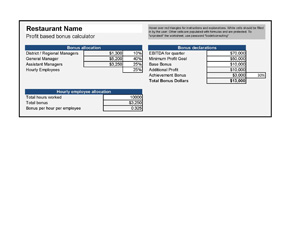
Bonus Plan Calculator picture

Bonus Plan Calculator Spreadsheet from our webstore

I suggest only using one thing to base your incentives on, the only thing that really matters, which is profit.

Whether you are encouraging upselling or controlling food costs, the ultimate goal is more profit to you. So rather than encouraging different segments of the staff to concentrate on different parts of the P&L, and setting the stage for them to fight with each other over what the other one is doing that is hurting their bonus, just cut out all the questions and bonus based strictly on your profit. From there, you have to educate your staff on all the nuances of achieving profitability. Then everyone has a common goal, and you don’t have issues like kitchen staff skimping on portions to try and hit a bonus. Bonusing someone for controlling your food costs doesn’t translate into profit if they also dissapoint your customers.

Visit our webstore to find a great bonus plan example and calculator to help you set up a simple profit-based bonus structure for your employees.

If you would like to buy this download from our webstore right now, click below:
Price: $15.00
Add to Cart